U of M Event lacks real understanding of access
By Bobbie Fields, MCIL Independent Living Team
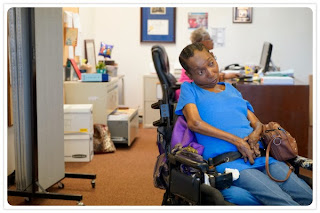
The University of Memphis and provost Karen West, held their first Top 10% Recognition Ceremony in which my niece, Kierra Fields, was one of many recipients for the scholars among the Shelby County High Schools graduating classes on December 5th, 2015. Being appreciated for all their hard work, it was a proud day for many parents and guardians of graduating seniors.
The Recognition Ceremony gave the young scholars an opportunity to speak with recruiters of their interest, each college dean, of many schools within University of Memphis, was in attendance at the event. The deans provided an on-site University of Memphis college application for those interested in attending this college.
However, there was one drawback for me personally, the accessible parking wasn't actually accessible. It was more like walk to the sidewalk, walk up the sidewalk, then proceed to your destination.
The parking lot sidewalks didn’t have curb cuts so I was forced to go out to the sidewalk, go down to the driveway and walk across the busy entryway. There was a small inlet in the sidewalk next to the driveway but it had a water grate in the middle with big holes. A wheelchair tires would get stuck in them.
The seating space for wheelchairs wasn’t adequate either. Some family members had to sit in the hallway and lobby. The organizer of this event clearly didn’t understand the meaning of accessibility for a person with a disability.
Sacramento, California - Governor Edmund G. Brown Jr. today announced the appointment of Michael Thomas, 55, of Sacramento, to the California State Rehabilitation Council. Thomas has been a client assistance program advocate at Disability Rights California since 2008, where he has been coordinator and senior advocate since 2003. He has been social security specialist and a disability rights advocate at Thomas Advocacy Consultants since 1999.
Thomas was a housing specialist for the Center for Independent Living from 2002 to 2003, where he was a benefits counselor from 1997 to 1998. He was a benefits specialist at the Houston Center for Independent Living from 2000 to 2002, a benefits and employment specialist for the Independent Living Resource Center from 1996 to 1997, an independent living specialist at the Memphis Center for Independent Living from 1994 to 1996 and an adjunct instructor at Shelby State Community College from 1995 to 1996.
Thomas was a graduate student teacher at California State University, Sacramento from 1992 to 1994 and a camera operator and production assistant at the Louisiana State University Medical Center from 1984 to 1986. He earned a Master of Arts degree in international and intercultural communications from California State University, Sacramento. This position does not require Senate confirmation and there is no compensation. Michael Thomas is a Democrat.
Editor's Note: No photo is available now for Michael Thomas. MCIL will undertake a review and index of our collection of historical photographs and slides this spring.

MATA may close the North End Terminal
The Memphis Bus Riders Union met Saturday December 12, at the Memphis Center for Independent Living to update the membership on MATA issues and vote on officers and amendments to the group’s by-laws. There were more than 20 members present and the meeting was followed by a Holiday Blowout party for MBRU and other grassroots groups in the Memphis area.
Most critically, MATA has limited use of the William Hudson North End Terminal downtown and they plan to close it completely for four months while it is renovated. MBRU was essential in getting needed improvements for riders at the terminal and the membership was concerned that the closure was a ploy to close the terminal permanently.
Currently the terminal has been closed to public parking and is used by the Memphis Police Department. MBRU noted much secrecy about the North End Terminal and nothing being discussed at the MATA board meeting.
Newly elected secretary Justin Davis noted that there was a “few pretty big changes that the executive committee was recommending for MBRU.” The members of MBRU voted to include dues in the monthly membership. Each member will pay from $3 to $50 each month or provide equivalent volunteer hours of work. Before the change, a member only needed to fill out an application. Booklets will be provided to members in good-standing that will show that they have paid their dues. The new by-laws will also divide the MBRU meetings into a public meeting first, followed by a meeting only for MBRU members.
Cindy Bailey and Sammie Hunter were re-elected as co-chairs of MBRU. Justin Davis was elected Secretary and Bennett Foster as Treasurer. Please make plans to attend the next meeting of the MBRU on January 9, 2016. The meeting will be at noon at the Memphis Center for Independent Living, 1633 Madison Avenue.
Action Alert: NCIL Needs Your Help Documenting the Impact of the DOL Rule Changes!
In August, when the Court of Appeals ruled in favor of the Department of Labor, the Home Care Association said that they were considering a Supreme Court appeal and asked if NCIL and ADAPT would be willing to write another amicus court brief in that case.
Months went by and the Home Care Association filed a petition to appeal to the Supreme Court with a motion asking the court to delay the implementation of the DOL rule until the Supreme Court decided if it would hear the case. The Supreme Court declined to delay the rule, but is allowing the Home Care Association to petition to have the appeal heard by the Supreme Court. The Home Care Association is, in fact, moving forward with petitioning the court and asked if we would file an amicus court brief with a deadline of December 24, 2015.
This brief is simply asking the court to hear the case. We are crafting an amicus emphasizing that the US Supreme Court should hear the case because the DOL's actions in changing the regulations have been harmful to attendants and people with disabilities.
In order to draft an accurate brief for the Supreme Court about how the Companionship Exemption changes have impacted people with disabilities, we need your help!
Please answer the questions below with details by Monday, December 14th! Send answers to Stephanie Woodward.
Explain how any state policies around attendant services have changed within the last 18 months. An example of this would be any rules implemented by your state that prohibit overtime for attendants.
Explain how any practices changed within the last 18 months. An example of this would be fiscal intermediaries requiring attendants to stop working overtime or people being reevaluated and receiving reduced hours that limits the potential for overtime.
Share stories of anyone who has been affected personally. Has an attendant lost hours of work?
Has a disabled person lost their attendants because of this? Is it impossible to find new attendants?
Has anyone been institutionalized as a result?
These examples will be very helpful to highlight the harm that is happening because of these rules.
Has your state done nothing to implement the rule?
Thank you for your help in addressing this critical issue!